

Injectable vs Topical Testosterone: What Are the Differences?
Injectable or topical testosterone, which delivery method fits your lifestyle? Learn the key differences and how PureRx's lab-guided TRT program can help you decide.
Once a clinical evaluation confirms that testosterone therapy is appropriate for you, one of the next decisions involves something many men don't expect to think about: how the medication is actually delivered.
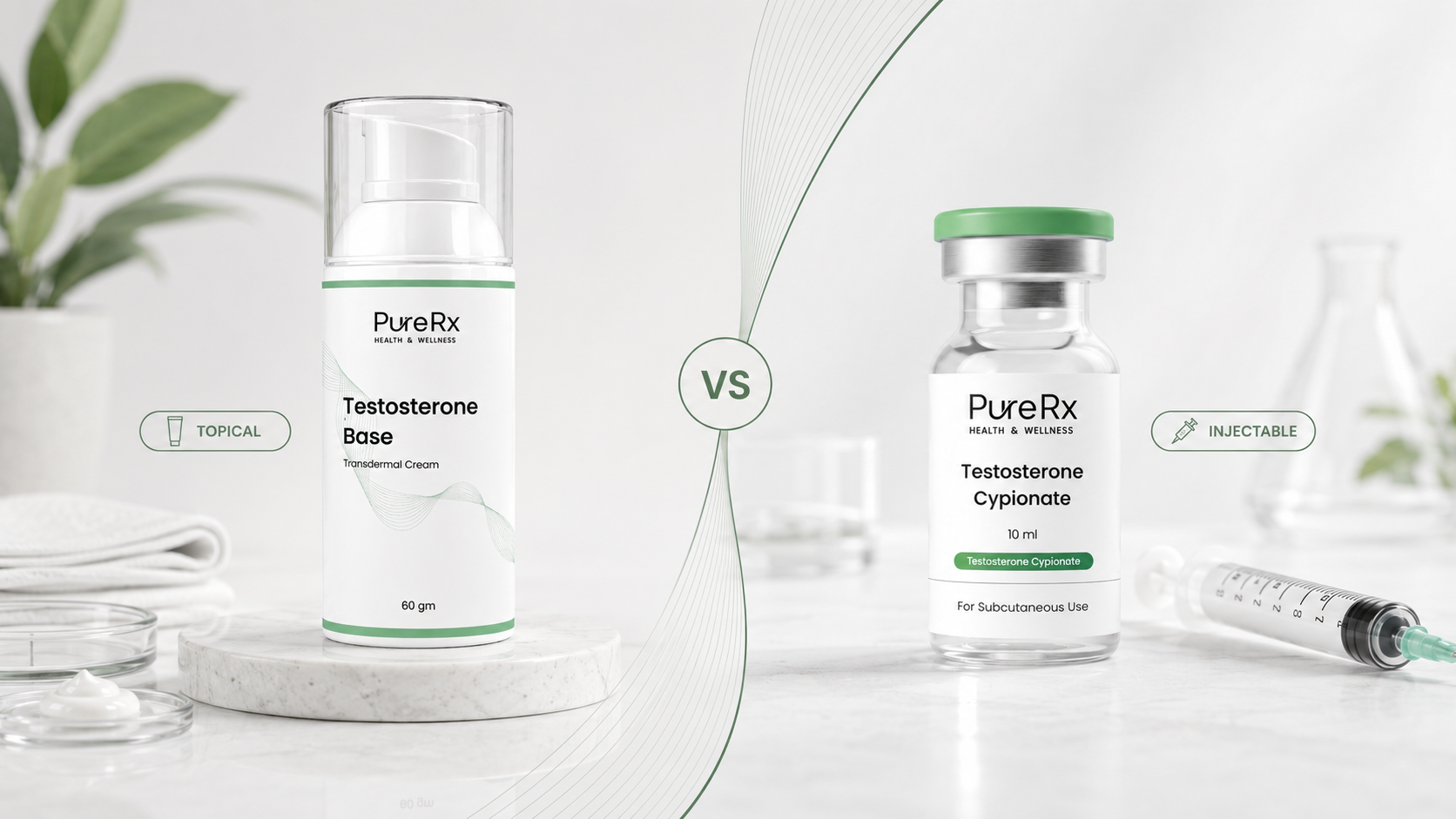
Injectable and topical testosterone are two of the most commonly considered formats in lab-guided TRT. While both aim to restore testosterone to a healthy physiological range, they work quite differently in practice.
Neither format is universally better. What's appropriate depends on your lab results, lifestyle, preferences, and what a licensed provider determines is clinically suitable for you. This blog breaks down how each option works so that you can have a more informed conversation during your consultation.
Why Delivery Format Matters
Testosterone therapy isn't just about whether to treat low testosterone; it's also about how. The delivery method affects how consistently testosterone levels are maintained, how convenient the routine is day to day, and how your body responds over time.
Treatment format is considered based on your symptoms, medical history, lab results, current medications, and provider review, never assumed or applied as a default. Both injectable and topical options are clinician-evaluated, with ongoing monitoring built into the process regardless of which format is selected.
Injectable Testosterone: What to Know
Injectable testosterone is one of the most widely used and longest-established delivery formats in TRT. It involves administering testosterone directly into muscle tissue, typically on a weekly or biweekly schedule depending on the specific compound and your provider's dosing plan.
Key characteristics:
✦ Administered via intramuscular injection, usually self-administered at home after proper instruction
✦ Common compounds include Testosterone Cypionate, Enanthate, Propionate, and Undecanoate, each with different absorption rates and dosing intervals
✦ Dosing schedule is flexible and adjusted based on lab response and symptom tracking
✦ Tends to produce more stable, predictable blood levels between doses compared to some alternative formats
✦ Requires comfort with self-injection, or willingness to learn the technique
Many men find that once the initial learning curve is past, injections become a quick, low-friction part of their routine. The dosing flexibility also gives providers more room to fine-tune levels based on how your body responds, a meaningful advantage for some patients during the optimization phase of treatment. This format is reviewed and selected through your provider's clinical judgment, with follow-up built into the plan from the start.
Topical Testosterone: What to Know
Topical testosterone offers a needle-free alternative, applied daily to the skin in gel or compounded cream form. For men who prefer to avoid injections altogether, this format provides a meaningfully different experience while still working toward the same clinical goal.
Key characteristics:
✦ Applied once daily, typically to the shoulders, upper arms, or abdomen, depending on the specific product
✦ No needles or self-injection required
✦ Levels are maintained through consistent daily application rather than periodic dosing
✦ Requires careful attention to application instructions to avoid transfer to others through skin contact
✦ May involve more day-to-day variability in absorption depending on skin condition, sweating, or application consistency
For men who simply prefer not to use needles, or whose lifestyle makes daily application easier than a weekly injection schedule, this format offers a practical and effective alternative, reviewed for appropriateness based on your symptoms, preferences, and overall clinical picture.
How the Two Compare
When weighing injectable versus topical testosterone, a few key differences tend to stand out.
In terms of administration, injections are given on a periodic schedule, typically weekly or biweekly, while topical formats require daily application without exception. Some men prefer the "set it and forget it" rhythm of a weekly injection; others prefer the routine simplicity of a daily application with no needles involved.
In terms of level stability, injectable testosterone often produces more consistent blood levels between doses, since the compound is released gradually from muscle tissue. Topical formats depend on daily consistency, and absorption can vary slightly based on skin factors, making day-to-day levels somewhat less predictable for some patients.
In terms of lifestyle fit, injectables suit men who are comfortable with self-administration and prefer fewer, less frequent doses. Topical options suit men who want to avoid needles entirely, even if that means a daily routine instead of a weekly one.
In terms of safety considerations, injectable testosterone requires proper technique and site rotation to avoid irritation, while topical testosterone requires care to prevent transfer to partners, children, or pets through skin contact, a factor that matters for men with young families or close physical contact in their daily life.
In both cases, ongoing lab monitoring is a built-in part of the process, with levels checked regularly, especially early on, to confirm they're staying within a healthy range and to guide any dosing adjustments.
What About Oral and Other Alternatives?
Injectable and topical formats aren't the only options considered as part of personalized TRT planning. In select cases, oral or other delivery formats may be reviewed based on lab results, medical history, and your individual care plan. These alternatives are evaluated case by case and may be appropriate for specific clinical situations where injectable or topical options aren't the ideal fit.
Your provider will walk you through all the formats that may be clinically relevant for your situation, not just the two most common ones, so that the final decision reflects your full health picture.
Will My Choice Affect Fertility?
This is a question worth raising early, regardless of which delivery format you're considering. Testosterone therapy can affect natural testosterone production and sperm count, and this consideration applies across delivery formats, not just one. If fertility is a priority for you, it's worth raising directly with your provider, who can walk you through fertility-preserving strategies or alternative approaches before you start treatment, which may include incorporating HCG into your plan where clinically appropriate.
How Long Until You Notice a Difference?
Regardless of which format you choose, the general timeline for results tends to follow a similar pattern. Many men notice improvements in energy, mood, and mental clarity within the first few weeks, while changes in body composition, strength, and libido typically develop more gradually over several months as levels stabilize.
Delivery format affects convenience and day-to-day experience far more than it affects the underlying timeline of physiological response, which is one more reason the decision often comes down to lifestyle fit rather than effectiveness alone.
So, Which One Is Right for You?
There's no universal answer here, and that's by design. Dosing, delivery method, and treatment adjustments are customized based on how your body actually responds, not preset protocols applied across the board.
A few honest questions can help guide the conversation during your testosterone evaluation: Are you comfortable with self-injection, or would you strongly prefer to avoid needles? Does a weekly routine fit your lifestyle better than a daily one? Do you have close physical contact with a partner, children, or pets that makes topical transfer a meaningful concern? Is consistent, predictable dosing a priority for you during the early optimization phase?
Your answers, combined with your lab results and clinical profile, will help your provider recommend the format that's genuinely appropriate for your situation, not just the most commonly chosen one.
Connecting the Bigger Picture
For men whose low testosterone is contributing to broader health concerns, addressing related areas alongside TRT often leads to more complete outcomes. If reduced libido or erectile changes are part of your symptom picture, exploring sexual health care alongside testosterone therapy may be worth discussing with your provider.
Similarly, if low testosterone has contributed to increased body fat or reduced muscle mass, incorporating medically guided weight management into your broader care plan may support more sustained results. Hormonal and metabolic health are closely connected, and addressing both together tends to produce more complete outcomes than treating either in isolation.
Start With the Right Conversation
Choosing between injectable and topical testosterone isn't something you need to figure out alone. Before starting treatment, you'll complete comprehensive lab testing, a medical intake, and a consultation, where a licensed provider reviews your symptoms, history, and goals, then recommends a plan only if it's clinically appropriate.
Schedule a free consultation with a licensed PureRx provider today. Whether injectable, topical, or another format ends up being right for you, the decision will be grounded in your actual lab data and health profile, not guesswork.
Disclosure: Treatment options vary by patient. Any compounded medication prescribed is not FDA-approved and is not the same as an FDA-approved drug. Results vary by individual. This content is for informational purposes only and does not constitute medical advice.